March 14, 2026
Table of Contents
The Numbers Tell a Story
Singapore just established a National AI Council chaired by Prime Minister Wong, committed over S$1 billion to AI research and development, and set a target to train 100,000 workers to become “AI Bilingual” by 2029. Four national AI missions are underway across manufacturing, logistics, finance, and healthcare. AI adoption among local SMEs tripled from 4.2% to 14.5% in a single year.
The ambition is real. But so is the opportunity gap.
Globally, 88% of organizations use AI in at least one function, yet only 6% capture significant business value. Around 94-95% of enterprise AI pilot projects have not yet delivered measurable results at production scale. Organizations are investing aggressively - and the ones who figure out the execution piece will pull far ahead.
The question is not whether to invest in AI. That debate ended in 2024. The question is how to close the gap between investment and impact - and what the most successful organizations are doing differently.
Three Traps Worth Avoiding
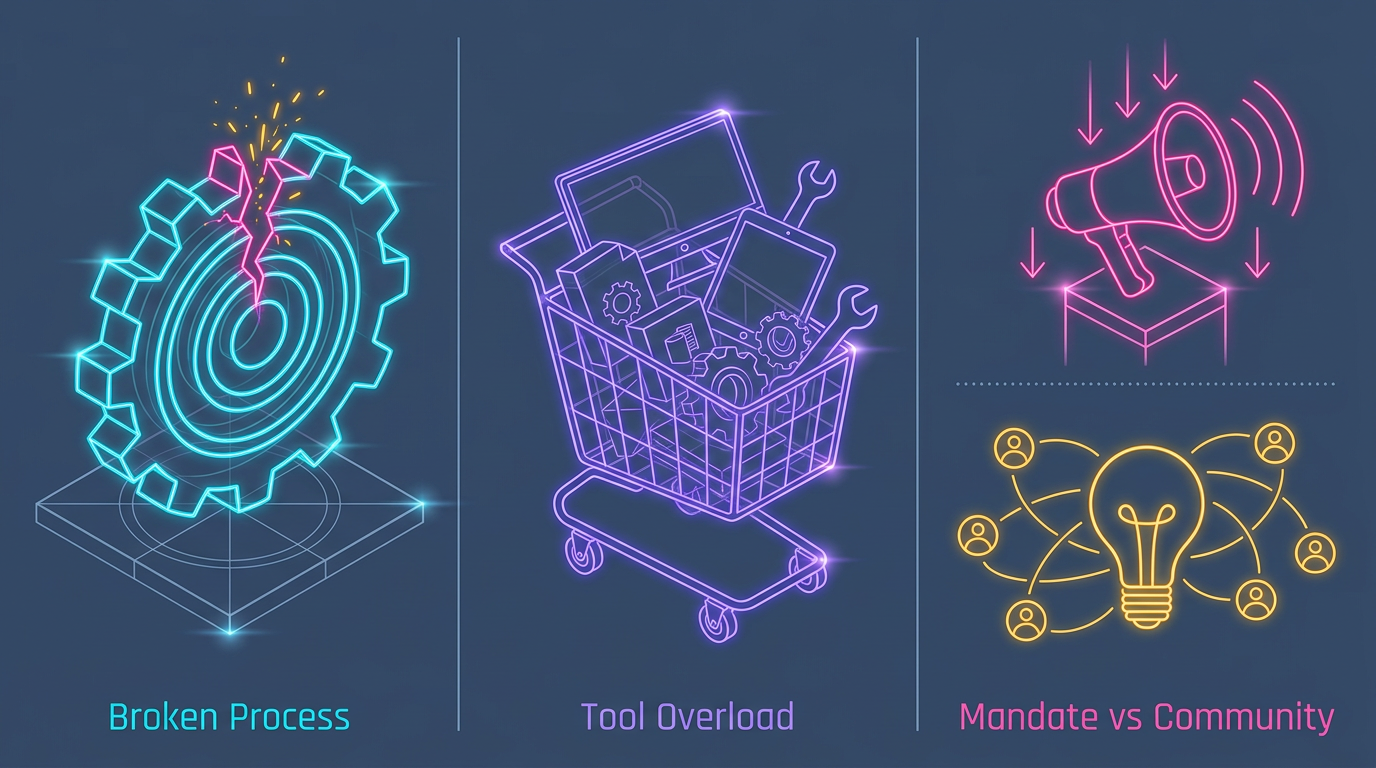
After years of building AI agents, designing multi-agent architectures, and observing how AI adoption unfolds across different environments, three patterns consistently separate the organizations that gain momentum from the ones that stall.
Trap 1: Automating Broken Processes
The most common misstep is deploying AI onto chaotic, undocumented workflows and expecting automation to sort things out. AI amplifies whatever it touches. Clean processes become faster. Messy processes generate expensive noise at scale. The organizations that gain traction map and simplify their processes first, then bring AI into a clean foundation.
Trap 2: Buying Tools Instead of Building Capability
Subscribing to AI tools is a starting point, not a destination. When organizations measure success by adoption metrics - login counts and license utilisation - they risk mistaking activity for transformation. The real signal comes from business outcomes: cycle time reduction, cost savings, and revenue growth. Engagement and activation matter as the first step, but the journey must lead to measurable impact.
Trap 3: Top-Down Mandates Without Bottom-Up Builders
Mandated rollouts often struggle because approved tools do not always match real workflows. Consider this: one major enterprise achieved only 8% adoption of its flagship AI agent tool despite full executive backing and mandatory training. Meanwhile, Citi built a grassroots network of 4,000+ AI champions across 182,000 employees in 84 countries and reached over 70% adoption - by empowering peer-led experimentation.
The research is clear: 93% of senior data and AI leaders identify cultural factors and change management as the primary barrier to AI adoption. Technology accounts for just 16% of failures. This is worth pausing on - the biggest lever for AI transformation is not technical at all.
Where Transformation Actually Happens
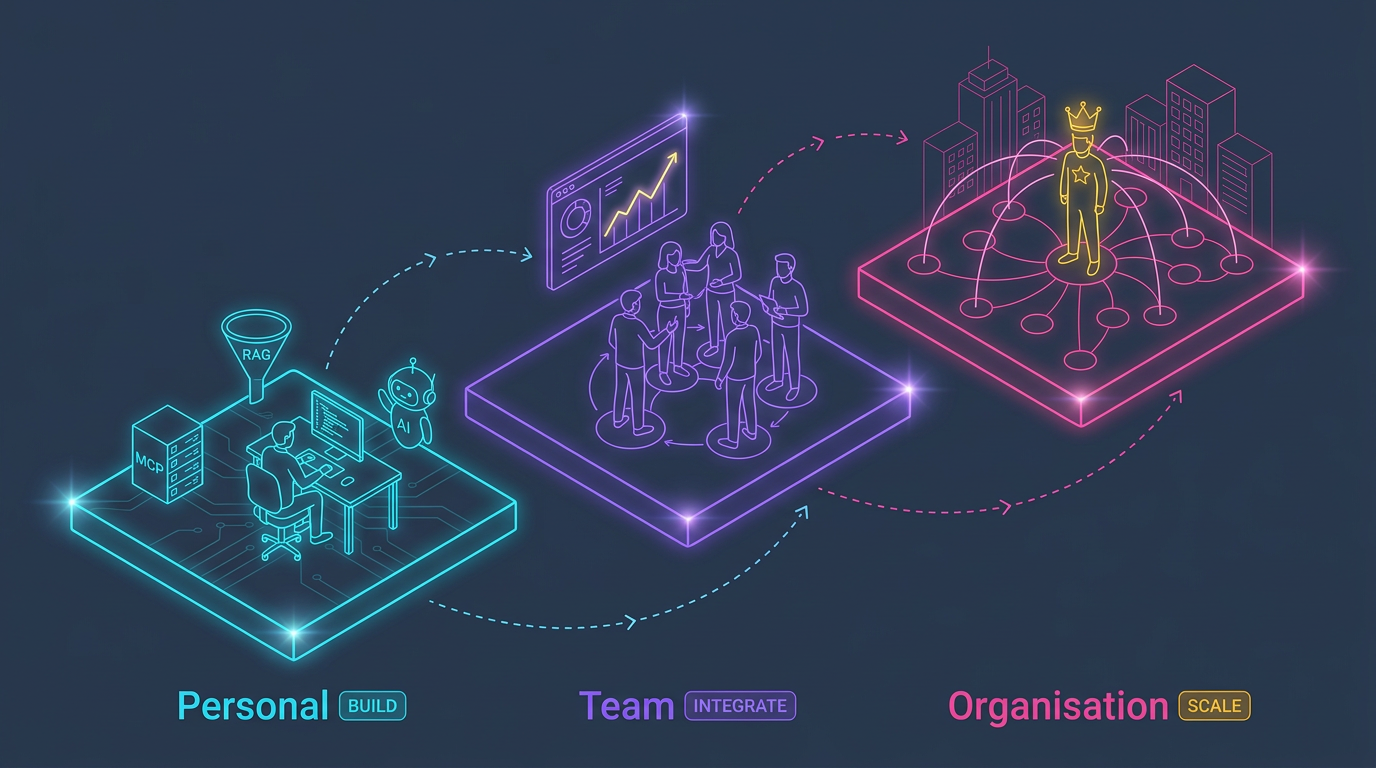
The organizations that crack AI transformation share an interesting pattern. They do not start with strategy decks or vendor evaluations. They start with people who build things. In my experience, real transformation happens across three distinct layers - and the order matters.
Layer 1: Personal - Build Before You Buy
AI fluency does not come from webinars or certification courses alone. It deepens through building. Writing MCP servers that connect AI agents to calendars, emails, and databases. Tuning RAG pipelines until retrieval quality stops hallucinating on edge cases. Designing multi-agent architectures where a research agent feeds findings to a writing agent, which gets reviewed by an editing agent. These are projects anyone can start today - with a laptop, an API key, and curiosity.
This hands-on building teaches things no course covers. You learn that context engineering - managing what information an agent sees, when it sees it, and how it is structured at runtime - matters far more than prompt engineering. You discover that memory management is the single biggest open challenge in agent architecture. You realize that in production RAG systems, simple recursive character splitting at 512 tokens consistently outperforms fancier semantic chunking approaches.
These are insights that only come from building. Whether you start with a cloud API, a local model, or a pre-built agent framework does not matter. What matters is getting your hands dirty with real problems. Transformation starts with individuals who develop genuine AI fluency through building - and that fluency becomes the foundation for everything else.
Layer 2: Team - Integrate, Do Not Bolt On
When individuals build real capability, teams absorb it naturally. AI-integrated development workflows emerge - not because someone mandated a tool, but because a team member demonstrated something compelling that the rest of the team wanted to adopt.
This is where the impact becomes measurable. When organizations properly implement agentic AI across their software development lifecycle - combining AI code generation with context-aware code review, architecture governance, and automated testing - the results show up clearly in delivery metrics. Teams that have done this well report meaningful improvements: deployment frequency increasing 30-40%, lead times dropping significantly, and change failure rates decreasing rather than spiking. Google’s DORA metrics framework, now complemented by a “rework rate” metric for AI-generated code, provides the measurement backbone for tracking this progress.
The key insight is that AI does not replace engineering discipline - it rewards it. Teams with strong processes, clear architecture standards, and good review practices see those strengths amplified. The investment in people and process foundations pays outsized returns when AI enters the picture.
Layer 3: Organisation - Community Over Mandates
Scaling from teams to the entire organisation requires a fundamentally different approach from traditional technology rollouts. The most effective model is community-led adoption: identify naturally influential people across departments, equip them as AI champions, and let them demonstrate practical value to their peers.
Microsoft’s internal “Frontier Forge” programme started as a hackathon and evolved into a community of nearly 100 contributors - non-technical employees building agentic solutions that reduced multi-week tasks to minutes. PwC Netherlands scaled from 300 AI enthusiasts to all 6,000 employees in roughly one year using organisational network analysis to find the right champions.
The common thread: adoption scales socially, not hierarchically. People trust peers who show them something useful far more than mandates that tell them to change.
The Gap Is Widening - And That Is an Opportunity
BCG’s research reveals a significant performance divide: the top 5% of companies that have deeply embedded AI achieve twice the revenue growth and 40% greater cost savings compared to the majority. In Southeast Asia, 82% of SMBs remain in the experimentation phase, and roughly half of all enterprise AI proofs-of-concept have not yet reached production.
But here is the encouraging part: the gap means the opportunity is still wide open. The leaders are not decades ahead - they are months ahead. The differences that separate them come down to execution patterns that any organization can adopt:
- They start with specific, high-impact use cases rather than broad experimentation
- They invest heavily in enabling people, not just deploying technology
- They build internal communities that sustain momentum after the initial launch energy fades
- They measure business outcomes from day one, creating a flywheel of evidence that justifies continued investment
Singapore’s S$1 billion investment, 100,000-worker training programme, and 10,000-enterprise support initiative through the National AI Impact Programme are designed to accelerate exactly this kind of execution. The infrastructure and funding are being put in place. The organizations that move decisively now - building real capability rather than waiting for the perfect strategy - will be the ones that capture disproportionate value.
What Actually Works
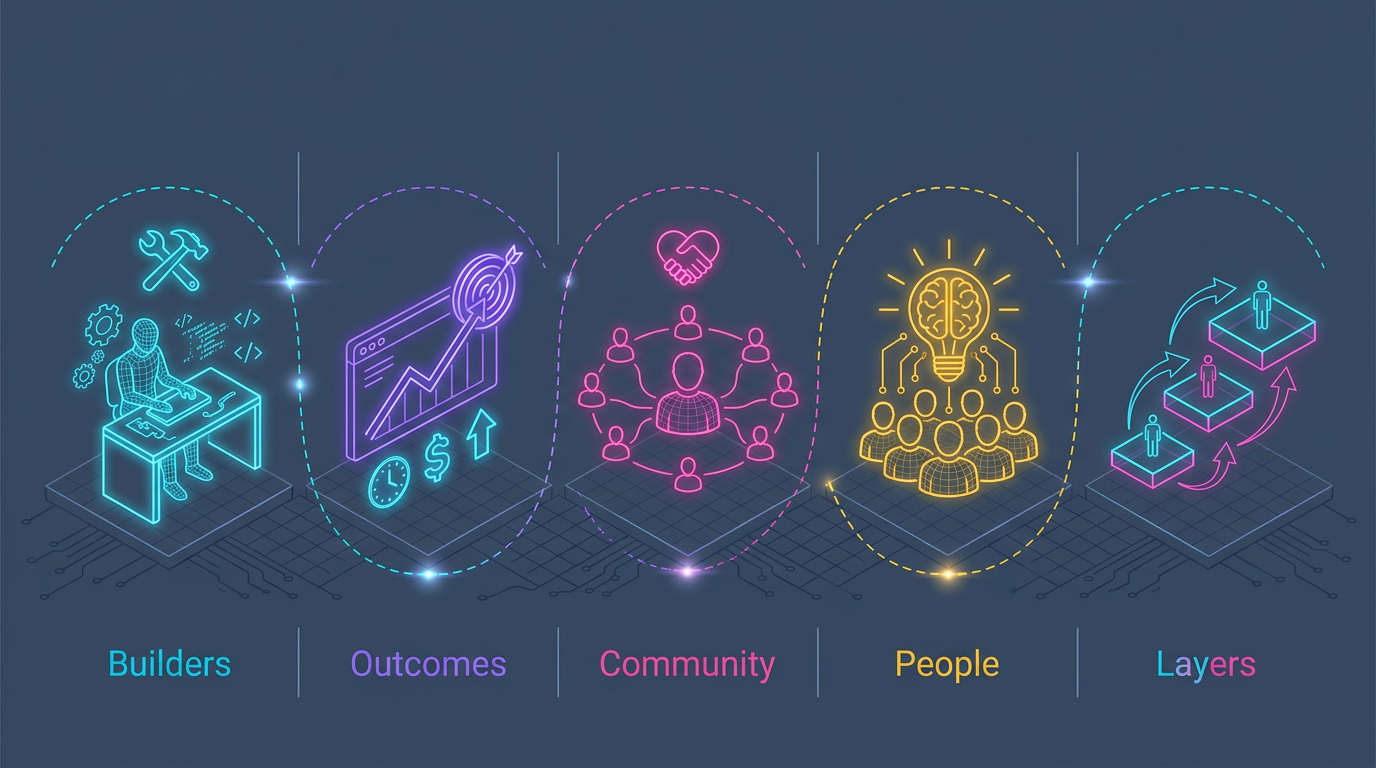
If I had to distil everything into a framework:
| Principle | What It Means |
|---|---|
| Start with builders, not buyers | Fund people who build AI solutions, not just AI subscriptions |
| Measure outcomes over adoption | Track cycle time, cost reduction, and revenue impact - engagement and activation are the vital first step, but outcomes are the destination |
| Build community, not mandates | Empower champions who demonstrate value through peer influence |
| Invest disproportionately in people | Technology enables, but people and process deliver the value |
| Design for layers | Personal fluency feeds team integration feeds organisational scale |
The Transformation Starts Before the Strategy Meeting
AI transformation is a top-down programme - leadership vision and investment are essential. But its movement must come from the bottom up. The organisations that will thrive are the ones where individuals are already building MCP servers that connect their AI agents to internal tools. Where teams are already measuring how AI changes their delivery metrics. Where communities of champions are already showing colleagues what is possible.
The most powerful thing a leader can do right now is simple: create the environment where builders can build, and get out of their way.
Sources
- Singapore Budget 2026: National AI Council and missions - The Business Times, Feb 2026
- Singapore National AI Strategy 2.0 - Smart Nation Singapore
- National AI Impact Programme - IMDA, Mar 2026
- A 5-Phase AI Maturity Model for the 2026 Enterprise - Maai Services Group
- AI in 2026: Why 94% of Companies Are Still Failing - Prajit Datta, Medium, Feb 2026
- Why 95% of Enterprise AI Pilot Projects Fail, Says TCS CEO - Bluetick Consultants, Feb 2026
- Stop Making These 6 AI Mistakes in 2026 - The AI Journal
- Why Most AI Rollouts Fail - Fast Company
- From Skeptics to Champions: Orchestrating Organizational Change in AI Adoption - Bosio Digital
- AI Champion Programs: Why, Who, How - Lead with AI
- Human and Organizational Challenges Continue to Slow AI Adoption - Lab Manager
- Context Engineering: The 6 Techniques That Actually Matter in 2026 - Towards AI, Feb 2026
- What We Learned Deploying AI Agents in Production for 12 Months - Viqus Blog
- RAG in Production 2026: Chunking Strategies and What Actually Works at Scale - Abhishek Gautam
- AI Code Review Is Quietly Destroying Your DORA Metrics - Here Is the Fix - DEV Community
- How to Measure DORA Metrics in the Age of AI 2026 - Plandek
- Why AI’s 10-20-70 Principle Should Matter To CEOs - Forbes, Jan 2026
- AI Transformation Is a Workforce Transformation - BCG
- “People Copy People”: AI Adoption Scales Socially - Lead with AI
- The Frontier Firm: How Non-Technical Employees Are Forging Their Own AI Tools at Microsoft - Microsoft Inside Track
- AI Leaders Outpace Laggards with Double the Revenue Growth and 40% More Cost Savings - BCG, Sep 2025
- Why 82% of SEA SMBs Are Stuck in AI Pilot Mode - Pertama Partners
- Half of Enterprise AI Deployments in Asia Pacific Never Reach Production - TechWire Asia, Mar 2026
Share :
You May Also Like

The Hard Truth About OpenClaw
The Gold Rush Every few months, a new open-source AI framework captures the collective imagination of the tech community. Right now, that spotlight belongs to OpenClaw. Forums light up with …
Read More
Scaled Agile Framework
I am not SAFe-certified. However, as an Agile enthusiast who has scaled engineering teams and delivered complex products, I have studied SAFe extensively and found it to be the most comprehensive …
Read More