You know the feeling. Late night, fresh idea buzzing, your AI coding companion humming along. You describe a function, sketch a UI, and poof - lines of code bloom onto the screen. Features materialize almost as fast as you can think them. I have spent enough late nights with Cursor, Claude, and various local models on my homelab to know this rush intimately.
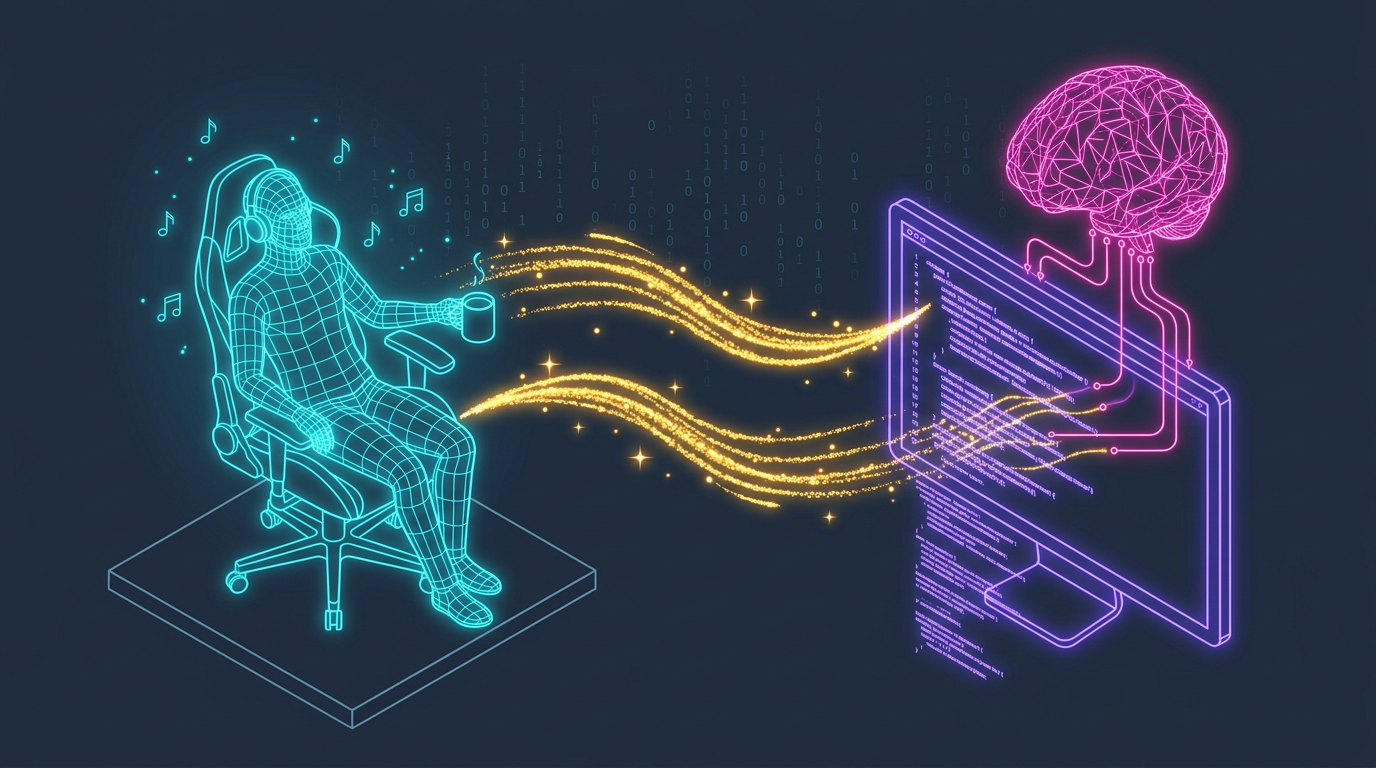

For a while, it feels like a cheat code. Your prototype springs to life, gathering early praise. The AI scaffolds APIs, untangles logic, and squashes bugs almost before you finish describing them. Pure, unadulterated building without boilerplate or ceremony. A GitHub survey found that 92% of developers now use AI coding tools - and most report significant productivity gains. The vibe is real. But so is the cliff that comes after it.
What Happens When the Vibe Stops Working?
The honeymoon does not last. Slowly, the project starts to sprawl. What began as a neat collection of scripts mushrooms into dozens of interconnected files - interconnected in ways that neither you nor your AI fully track.
You ask your AI to “refactor this messy module” or “find the root cause of this edge case.” The magic flickers. It forgets crucial context from five prompts ago. It suggests changes that introduce baffling side effects, or worse, it confidently deletes vital logic like a well-meaning but confused intern trying to “tidy up.”
That deafening silence when things break? That is the hard ceiling of pure vibe coding.
Why? Because even the most powerful models excel at pattern matching within a local context. What they lack is persistent, holistic understanding of the entire system’s architecture - the implicit assumptions, the coupling between modules, the long-term goals. They do not inherently grasp the ticking time bomb of storing critical data in memory “just for now.” They will not flag the gaping security hole in that unauthenticated API endpoint generated in a rush.
| What AI Does Well | What AI Misses |
|---|---|
| Generating code from clear descriptions | System-wide architectural implications |
| Pattern matching within local context | Implicit assumptions across modules |
| Scaffolding boilerplate and APIs | Long-term maintainability trade-offs |
| Fixing isolated bugs quickly | Cross-module coupling introduced by fixes |
| Writing tests for explicit behaviour | Testing for edge cases the spec never mentioned |
The pattern is consistent: AI excels at the local and struggles with the systemic. Recognizing where that boundary falls in your project is the critical skill. But where does that leave us as engineers?
How Does the Engineer’s Role Actually Evolve?
This is not a eulogy for the vibe. It is a recognition of where we are and a call to evolve with the tools:
| AI Maturity | AI Role | Your Role | Focus Shift |
|---|---|---|---|
| Today | Phenomenal junior developer | Senior developer | Code quality, testability, architecture, guiding AI output |
| Near Future | Reliable senior developer | Principal engineer | System-wide architecture, tech debt strategy, cross-team impact |
| Further Horizon | Principal-level system designer | Engineering leader | Team composition, business-tech alignment, innovation culture |
The constant is not obsolescence - it is evolution. As AI masters tasks at one level, human value shifts to the next level of strategic thinking and architectural wisdom.
The engineers who thrive with AI tools are not the fastest coders. They are the ones who can evaluate AI output critically, spot the architectural smell hidden in three files of generated code, and ask the right follow-up questions. The skill that matters most is no longer typing speed - it is judgment. Research from MIT confirms this: AI’s productivity boost is largest for tasks requiring judgment and evaluation, not raw coding speed. So what does the responsible path look like?
What Does Responsible Vibe Coding Look Like?
The trap is letting the ease of AI generation lead to neglecting the fundamentals. Unstructured vibe coding at scale accumulates tech debt, fragility, and ultimately slows you down far more than careful planning ever would.
flowchart TD
    A[Vibe Coding] --> B{Scale?}
    B -->|Small prototype| C[Ship it fast]
    B -->|Production system| D[Add architecture]
    D --> E[Define boundaries]
    E --> F[Review AI output]
    F --> G[Test rigorously]
    G --> H[Sustainable velocity]
    C --> I[Validate with users]
    I --> D
The decision point is scale. Vibe coding a weekend prototype? Ship it. Vibe coding a production system that will serve customers? Stop and add the architectural scaffolding first. The Mermaid diagram above captures this - there is a clear fork, and choosing the wrong path at the wrong time is where most projects accumulate irreversible debt.
We simply do not know when - or if - we can safely delegate the highest levels of complex judgment entirely to AI. For today and the foreseeable future, the human architect and the seasoned leader remain irreplaceable.
Key Takeaways
- Vibe to explore. Prototype. Iterate. Capture that initial spark. Let the AI be your incredibly productive collaborator in these early stages.
- Do not let the vibe build the cathedral. Without an architect’s blueprint and experienced engineers ensuring the foundation is solid, you are building on sand.
- The boundary is local vs. systemic. AI excels at generating code within a clear, bounded context. It struggles when the task requires understanding the whole system. Know where that line falls in your project.
- Judgment is the new typing speed. The ability to evaluate, critique, and direct AI output is more valuable than the ability to write code from scratch.
- Our future is not replacement - it is evolution. Continually reaching for the next level of thinking, leadership, and partnership with the tools we are building.
This week, do this: take a piece of AI-generated code you shipped recently and review it as if a junior engineer wrote it. Check for hidden coupling, missing error handling, implicit assumptions, and security gaps. The bugs you find will teach you more about effective AI collaboration than any tutorial.
You May Also Like
Unleashing the Power of Collaborative AIs
I spent months using ChatGPT and local LLMs as standalone assistants. They were impressive, but something kept bothering me. I would ask one model for a business strategy and get a decent plan - but …
Read More: Unleashing the Power of Collaborative AIs
Fun Things To Do With Self-Hosted Generative AI
Weekends are my time to break things and build things. My homelab runs a full generative AI stack - models, workflows, UIs - and I use that freedom to experiment with stuff that commercial services …
Read More: Fun Things To Do With Self-Hosted Generative AI