May 19, 2023
Table of Contents
A Real-World Example
Consider a scenario that illustrates where generative AI delivers genuine value. An online grocery platform wants to help busy professionals eat healthier. Using text generation, it creates personalized meal plans based on dietary preferences. Using image generation, it produces appetizing visual previews of each meal. The customer gets a tailored experience in seconds - what would have required a team of nutritionists and food photographers.
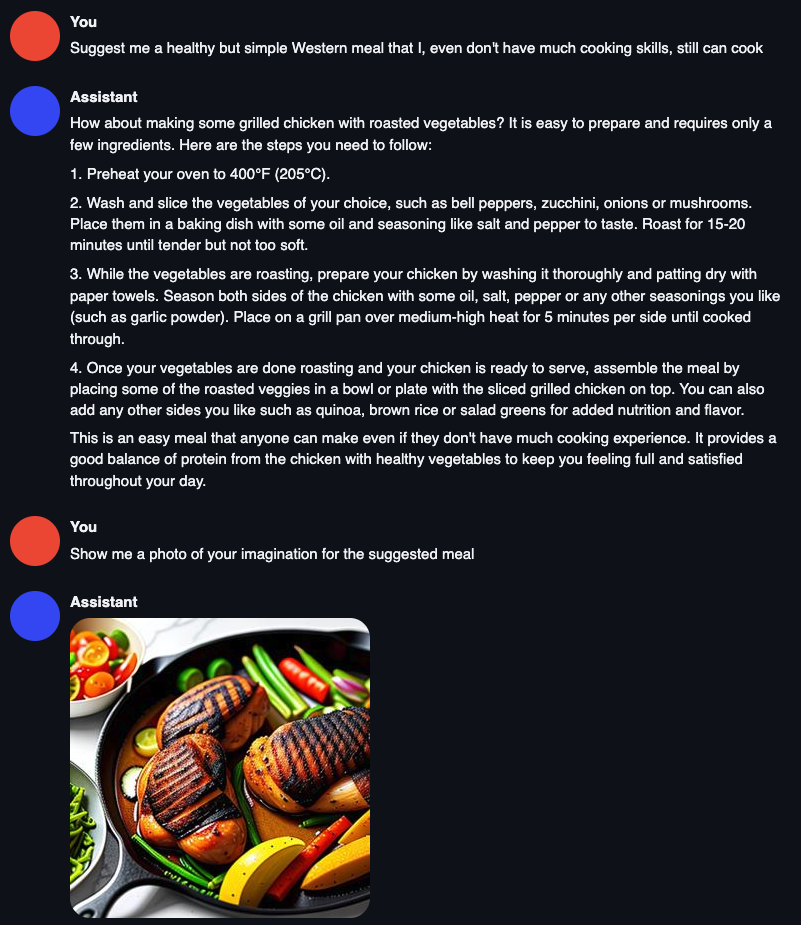
This is not hypothetical. The combination of text and image generation is already transforming how businesses interact with customers, create content, and design products. The question is no longer whether to adopt it, but where to apply it for maximum impact.
Where the Value Is
After experimenting with both text and image generative AI on my homelab and observing enterprise adoption patterns, I see six areas where the technology delivers the most compelling ROI:
| Application | What It Does | Business Impact |
|---|---|---|
| AI-Powered Design | Generate customized web designs, patterns, and illustrations | Faster iteration, personalized brand experiences |
| Automated Content | Generate articles, social posts, product descriptions at scale | 10x content velocity with consistent brand voice |
| Virtual Design Collaboration | AI creates variations from artist inputs, combining styles | Unlocks remote creative collaboration |
| Custom Product Design | Generate product mockups from user preferences | Higher engagement, new revenue from personalization |
| AI-Assisted Copywriting | Generate slogans, ad copy, email campaigns | Reduces creative bottleneck, enables A/B testing at scale |
| Personalized E-Commerce | Tailored descriptions and product images per customer | Higher conversion rates, better customer experience |
flowchart TD
    A[Generative AI] --> B[Text Generation]
    A --> C[Image Generation]
    B --> D[Content Automation]
    B --> E[Copywriting]
    B --> F[Personalization]
    C --> G[Design Generation]
    C --> H[Product Mockups]
    C --> I[Visual Collaboration]
    D & E & F & G & H & I --> J[Business Value]
The Practical Reality
From my own experience running Stable Diffusion and language models locally, here is what I have learned about applying generative AI in practice:
Text generation is more immediately useful than image generation for most businesses. Generating product descriptions, email drafts, and documentation delivers measurable time savings from day one. Image generation, while impressive, requires more curation and quality control before it is production-ready.
The quality bar is rising fast. When I started experimenting with local models in early 2023, the output required significant human editing. By mid-2023, models like Llama 2 and DreamShaper were producing content that needed only light touch-ups. The trajectory suggests that within a year or two, the gap between AI-generated and human-created content will be imperceptible for most use cases.
Customization is the moat. Generic AI output looks generic. The businesses that win are those that fine-tune models on their own data - their brand voice, their design language, their customer profiles. Self-hosted models make this possible without exposing proprietary data to third parties.
The Challenges
The technology is powerful, but adoption is not straightforward:
- Talent gap. Finding people who understand both the AI capabilities and the business domain is difficult. Most teams have one or the other.
- Infrastructure costs. Running models locally requires GPU investment. Cloud APIs are convenient but create vendor dependency and recurring costs.
- Quality control. AI output is probabilistic, not deterministic. You need human review processes, especially for customer-facing content.
- Ethical considerations. AI-generated content raises questions about attribution, authenticity, and disclosure that most organizations have not addressed.
- Integration complexity. Plugging generative AI into existing workflows - CMS, e-commerce platforms, design tools - requires engineering effort that is often underestimated.
Key Takeaways
- Start with text generation - it delivers the fastest ROI with the lowest risk
- Self-host when privacy or customization matter - fine-tuning on your own data is where the real competitive advantage lives
- Invest in quality control pipelines - the AI generates; humans curate and approve
- Think beyond content creation - the most transformative applications combine text and image generation to create entirely new customer experiences
- Move now, iterate later - the technology is evolving fast, and the organizations that start experimenting today will compound their advantage
The era of generative AI is not coming - it is here. The businesses that figure out how to apply it practically, not just theoretically, will define the next decade of their industries.
Share :
You May Also Like

The Modern Leader
The False Dichotomy A bad manager sacrifices people for numbers. A good manager sacrifices numbers for people.
Read More
Tech Debt: From a Technical Jargon to Real-World Impacts
What Started This I recently gave a presentation at my company about tech debt - sharing knowledge, techniques, and experiences on how to manage it properly and efficiently. The response convinced me …
Read More